Introduction
Maintaining spine health is fundamental to overall well-being, as the spine serves as the primary support system for the body. When spine conditions arise—whether due to injury, aging, or underlying disorders—they can significantly impact mobility, comfort, and the ability to perform daily activities. Given the complexity of the human spine, accessing specialized medical care is essential for effective diagnosis and treatment.
Patients often find it challenging to navigate the vast array of available medical facilities to determine which ones offer the most suitable expertise for their specific needs. Choosing the right institution is a critical decision that directly influences the success of your care journey. BESTSPINEHOSPITALS serves as a dedicated resource to help patients understand their options, research specialized centers, and grasp the importance of selecting the right team for their spine health requirements.
Understanding Spine Health
The spine is a complex structure composed of vertebrae, intervertebral discs, nerves, muscles, and the spinal cord. It provides structural support to the body while protecting the spinal cord, which is vital for nerve communication.
- Vertebrae and Discs: These structures provide the column’s strength and shock absorption.
- Spinal Cord and Nerves: These are essential for transmitting signals between the brain and the rest of the body.
- Muscles and Ligaments: These support movement and stability.
Because the spine facilitates movement and protects vital neurological pathways, any dysfunction can lead to significant discomfort and loss of function.
Common Spine Conditions That Require Specialized Care
Spine conditions vary widely in severity and treatment requirements.
Herniated Disc
Occurs when the soft center of a spinal disc pushes through an exterior tear. It can cause pain, numbness, or weakness in limbs depending on the location of the pressure on a nerve.
Spinal Stenosis
A narrowing of the spinal canal, which puts pressure on the spinal cord and nerves. It is often a result of age-related wear and tear.
Scoliosis
Characterized by an abnormal sideways curvature of the spine. While often identified in childhood, it can also develop or progress in adults.
Degenerative Disc Disease
Involves the gradual deterioration of the intervertebral discs, which can lead to chronic pain and reduced flexibility.
Spinal Fractures
Often caused by trauma or osteoporosis. These require prompt evaluation to ensure spinal stability and nerve protection.
Spinal Tumors and Complex Conditions
These represent serious medical scenarios that necessitate highly specialized evaluation by multi-disciplinary teams.
Common Symptoms of Spine Problems
If you experience persistent symptoms, it may be time to consider a professional evaluation. Common indicators include:
- Chronic back or neck pain.
- Limited range of motion in the spine.
- Numbness or tingling sensations in the extremities.
- Muscle weakness.
- Balance or coordination difficulties.
- Radiating pain that travels down the arms or legs.
- Difficulty completing standard daily tasks.
Why Choosing the Right Spine Hospital Matters
The facility you select for your care can profoundly influence your treatment journey.
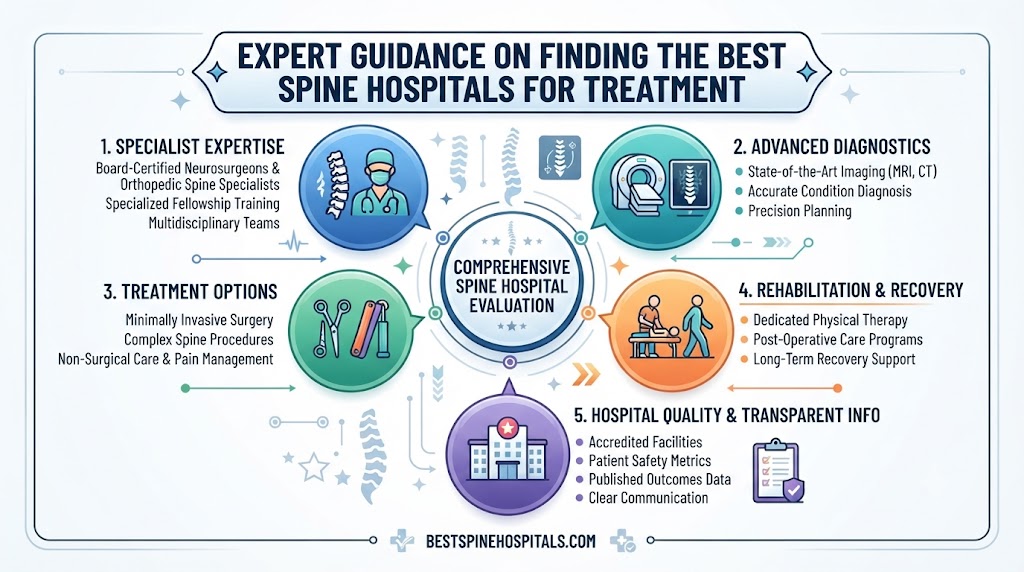
- Specialized Medical Expertise: Leading spine hospitals house experienced orthopedic spine specialists and neurosurgeons who work in collaborative, multi-disciplinary teams.
- Advanced Diagnostic Facilities: High-quality centers utilize sophisticated imaging (MRI, CT scans) to achieve an accurate diagnosis, which is the cornerstone of effective treatment.
- Treatment Options: Reliable hospitals offer a full spectrum of care, from non-surgical physical therapy to state-of-the-art minimally invasive and complex surgical interventions.
- Rehabilitation Support: Recovery is not just about the procedure; it is about guided physical therapy and long-term management to restore mobility and health.
How to Find the Best Spine Hospitals
When evaluating potential facilities, focus on these critical areas:
- Spine Specialist Experience: Look for doctors who have a deep, specialized history in treating your specific condition.
- Hospital Infrastructure: Does the facility have the specific diagnostic and surgical support systems necessary for spine care?
- Treatment Approach: Prioritize hospitals that offer personalized, evidence-based treatment plans tailored to the individual patient.
- Patient Support Services: Quality care includes clear communication, assistance with coordination, and robust recovery guidance.
- Transparency: You should feel informed about your procedure, the risks, and the expected outcomes.
Spine Hospital Comparison Factors
| Factor | Why It Matters |
| Specialist Expertise | Ensures the medical team has relevant experience for your diagnosis. |
| Diagnostic Facilities | Provides the accuracy needed for a successful treatment strategy. |
| Treatment Options | Offers a range of non-surgical and surgical solutions. |
| Rehabilitation Support | Facilitates essential recovery and strength building. |
| Patient Services | Enhances comfort and clarity throughout your healthcare journey. |
Diagnosis Process for Spine Conditions
An accurate diagnosis typically involves a systematic approach:
- Medical History: A review of your symptoms, past injuries, activity levels, and overall lifestyle.
- Physical Examination: Assessing nerve function, reflexes, and spinal movement.
- Imaging Tests: X-rays, MRIs, or CT scans are used to visualize the internal structure of the spine.
- Additional Tests: In some cases, nerve conduction studies or other specialized evaluations may be required to pinpoint the source of pain.
Spine Treatment Options
Non-Surgical Treatments
Many patients find relief through physical therapy, targeted medication management, lifestyle adjustments, and activity modification. These are often the first line of defense.
Minimally Invasive Treatments
When non-surgical methods are insufficient, these procedures use smaller incisions to treat conditions, often leading to different recovery timelines compared to traditional open surgery.
Spine Surgery
Surgery is considered when other treatments have failed or when there is evidence of nerve or spinal cord compromise. It is vital to consult with a specialist to discuss the surgical approach best suited to your diagnosis.
Recovery and Rehabilitation After Spine Treatment
Recovery is a gradual process that relies heavily on rehabilitation.
- Physical Therapy: Exercises to regain strength, flexibility, and stability.
- Mobility Recovery: A structured return to daily activities.
- Follow-up Appointments: Essential for monitoring your healing progress.
- Lifestyle Adjustments: Long-term changes to support a healthy spine.
Factors That Influence Spine Treatment Decisions
Treatment is never one-size-fits-all. Decisions are influenced by:
- The specific type and severity of the spine condition.
- The patient’s age and overall physical health.
- Activity levels and lifestyle goals.
- Previous treatments attempted.
- The expert evaluation provided by your specialist.
Preparing for a Spine Consultation
Make the most of your appointment by bringing:
- A comprehensive list of symptoms.
- All relevant medical reports and previous imaging results.
- Information on current medications.
- A summary of your treatment history.
- A list of questions regarding your condition and potential options.
Common Mistakes Patients Make While Choosing Spine Care
- Prioritizing Cost: Low-cost options may lack the specialized expertise needed for complex spine issues.
- Ignoring Experience: The specialist’s track record with your specific condition is paramount.
- Delaying Consultation: Early evaluation often leads to more effective, less invasive options.
- Incomplete Information: Not fully understanding the treatment plan or expected recovery.
- Skipping Rehabilitation: Recovery requires active participation in physical therapy.
Myths vs Facts About Spine Treatment
| Myth | Fact |
| All spine problems require surgery | Many conditions are successfully managed with non-surgical approaches. |
| Severe back pain always means serious damage | Pain is a symptom; proper evaluation is needed to determine the cause. |
| Recovery ends after treatment | Rehabilitation and follow-up are critical for long-term health. |
| Any hospital can handle complex spine conditions | Specialized spine centers provide dedicated expertise for complex cases. |
How BESTSPINEHOSPITALS.COM Supports Spine Healthcare Awareness
BESTSPINEHOSPITALS.COM is dedicated to providing educational resources that help patients demystify spine care. By offering information on treatment options and guidance on evaluating hospitals, the platform empowers individuals to navigate their healthcare journey with greater confidence and clarity.
Future of Spine Healthcare
The field is continuously evolving with advancements in diagnostic imaging, the expansion of minimally invasive surgical techniques, and the development of personalized rehabilitation programs, all aimed at improving patient outcomes and quality of life.
FAQs
- What are the best spine hospitals?
The best hospitals are those that offer specialized expertise, advanced diagnostic tools, and comprehensive rehabilitation programs. - How do I choose the right spine hospital?
Evaluate the center based on specialist experience, infrastructure, and the range of available treatment options. - What conditions are treated by spine specialists?
They treat conditions like herniated discs, stenosis, scoliosis, and spinal fractures. - When should I visit a spine specialist?
If you have persistent pain, numbness, or loss of function that interferes with daily life. - What qualifications should a spine surgeon have?
They should be board-certified with specialized fellowship training in spine surgery. - What tests are used to diagnose spine problems?
Common tests include physical exams, X-rays, MRIs, and CT scans. - Are all spine problems treated with surgery?
No, many conditions respond well to physical therapy and lifestyle modifications. - How long does spine treatment recovery take?
It varies widely depending on the procedure and individual health factors. - What factors affect spine treatment decisions?
Severity, diagnosis, age, and overall health. - What is the role of rehabilitation?
It helps restore mobility, strength, and function after treatment.
Final Thoughts
Choosing the right facility for your spine care is a significant decision that impacts your long-term health and mobility. By prioritizing specialist expertise, accurate diagnosis, and comprehensive rehabilitation, you can take control of your treatment path. We encourage you to explore BESTSPINEHOSPITALS for reliable information to help you make informed decisions about your spine health. Always consult with qualified healthcare professionals to discuss your individual condition and the best course of action for your unique needs.